| >> Versão Portuguesa | |
| 2026.07.23 Pons Varolii by Simão Costa; with video by Mário Melo Costa; Pedro Neves (conductor), Simão Costa (piano) and Lisbon Metropolitan Orchestra; July 19th, São Luiz Municipal Theatre, Lisbon. |
|
| A Bridge Halfway There PEDRO BOLÉO |
|
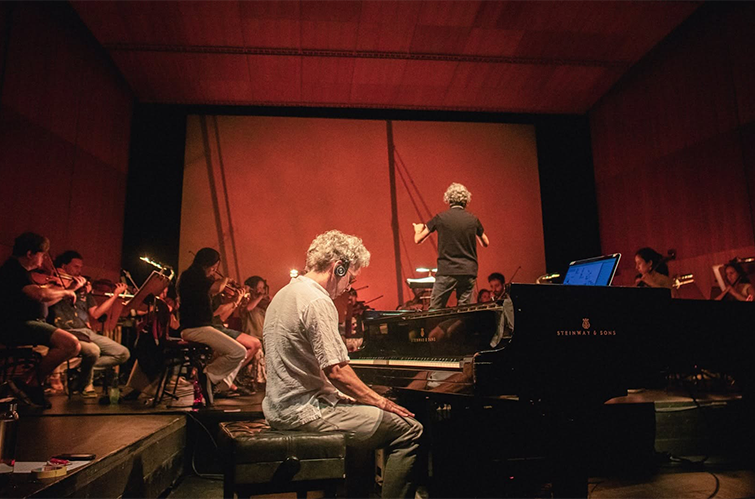 Pons Varolii, a work by the composer and pianist Simão Costa inspired by his ‘fascination’ with the April 25th bridge, had its premiere performance at the São Luiz Theatre in Lisbon on July 18th. The following day, on July 19th, with a well-attended audience, we went to hear this brand-new Simão Costa’s piece for piano and orchestra, accompanied by a video by Mário Melo Costa. ‘Pons’ comes from the Latin word for ‘bridge’. And ‘Pons Varolii’ is also a part of the human brain, which acts as a bridge between ‘vital functions’ and the more highly developed areas of the cerebral cortex. The title chosen by Simão Costa therefore relates to the April 25th bridge — its sound, its engineering, its architecture — but also to human biology and instinct. At the same time, it is a celebration of the 60th anniversary of the April 25th bridge, a structure that forms part of so many people’s daily lives, yet which we have never seen or heard in quite this way. It also offers another reflection, which the composer describes as a tribute ‘to memory and freedom’. 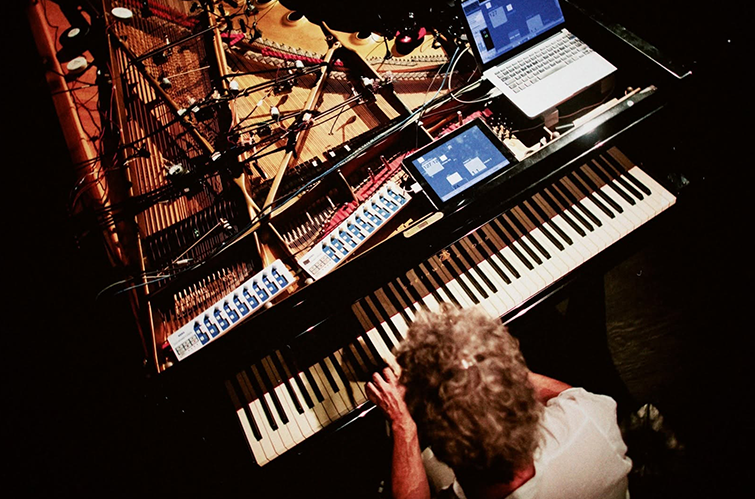 Simão Costa · © MãoSimMão In this ambitious proposal, it is impossible not to be reminded of the classical form (reinvented a thousand times) of the ‘concerto for piano and orchestra’, which Pons Varolii is not, although it maintains an open dialogue with the history of this pairing (Simão Costa’s transformed piano is, after all, always ‘memory and freedom’). There are various bridges, then. But the first bridge in Pons Varolii is the one that links the moving images to the sounds of the piano and orchestra, a bridge between arts that intersect, connect and cross over — music and video. Video and music are closely intertwined: rhythmic synchronisations between image and sound place us, right from the outset, before an audiovisual work that presents itself as dual in nature and moves in both directions, subsequently unfolding its intricate relationships. The piano had been lowered slightly into the stage lift, and Simão Costa took his seat in front of it (putting on headphones), allowing the audience to see the conductor Pedro Neves (also wearing headphones to ensure precise synchronisation), the Lisbon Metropolitan Orchestra (OML) and, behind them, the video projection by Mário Melo Costa. The video immediately ‘sets the tone’ for much of what is to follow, opening with high-angle shots of the structure of the April 25th bridge. The music also begins impetuously, with rapid gestures and rhythmic interplay, in a modernist style. The images bring to mind the cinema of Jean Vigo (A propos de Nice, for example) or the camerawork of Dziga Vertov. It is a camera that climbs to difficult places, looking up and down; an eye that ascends the April 25th bridge and gazes with fascination, yes, but without ever turning the bridge into a beautiful landscape. What stands out is the bridge’s physicality: its deck, its structures, the lines of the cables and steel beams that cross and support it. We shall then see, even more closely, bolts (there are said to be some three million of them) and joints, lampposts, towers, the road and the steel deck with holes through which the river can be seen. There are no postcard views of the bridge, just the strength of its structure, its form, its metallic power and, later, the movement that passes across it: cars, trains, air. Mário Melo Costa’s video served as the most immediate starting point for the musical composition, through a process of ‘alchemy’ (in this case, synesthesia) very much to Simão Costa’s liking, transforming the colours and rhythms of the image into raw data for the musical composition — translating into sound (or is it ‘transmuting’ into sound?) formal aspects of the moving images. Apart from offering a formal/material perspective on the bridge, where a human life made up of passages floats, the video makes extensive use of image saturation, blurring and superimposition; within it, a constant vibration pulsates — the bridge’s perpetual, noisy vibration, invisible and inaudible in the usual tourist postcard featuring Cristo-Rei alongside it. This posed a major challenge for the musical composition and for the piano: to engage with and confront this vibration of the images, these saturations, these ‘noises’ of the video and its rapid, agile editing. Yet Simão Costa’s musical creation was not always able to keep alive this visual and auditory vibration that his highly intriguing concept had led one to hope for. The piece begins with just the orchestra, in the first of ten sections, each lasting 4’33’’ (a nod to the duration of John Cage’s famous silent piece). Then comes the piano, suggesting that it might actively participate with its strings tightly stretched across the visual score in front of it, in the style of a ‘concerto’. But soon afterwards it settles into a couple of consonant chords and, although the music retains its liveliness by ‘tainting’ these chords with other sounds, what emerges is a cliché of film music, inevitable when music like this (repeated chords resonating on the piano) is superimposed onto moving images. Fortunately, shortly afterwards the music seeks fresh impetus and new directions, such as in a melodic repetition (in a loop) on the piano that the orchestra expands upon, whilst we see, for the first time in the footage, the train that also travels across the bridge and along its tracks. Once again, the camera is there, in places we have never been and are unlikely ever to visit, right in the middle of the bridge. A camera-eye in dangerous places, yet the music avoids them, sometimes preferring to sublimate the materiality of the April 25th bridge rather than follow the exhilarating path of its noisy vibration, its danger, from the inaudible to the never-before-seen (at least in this way). The creative path opened up by the idea of ‘listening to the bridge’ (which strikes us as one of the most interesting) is also present, but it seems to us that it stops halfway, thus avoiding the greater confrontation that would result from the piano more boldly proposing the unheard-of, with sounds and noises disrupting our placid vision of a noisy, dangerous, almost violent bridge. Or would it be a matter of giving ‘instinct’ freer rein, with fewer restraints? Perhaps we might also have expected more from the specific work on the piano, given what Simão Costa has been doing in the stimulating reinvention and creative detuning of this 300-year-old instrument, turning it inside out, altering its sound, and translating and transposing technical, historical and sonic bridges. This kind of work features far too discreetly in Pons Varolii. It lacks the edginess, the exploratory drive and the radicalism found in other works by this composer and researcher into the piano’s potential in relation to new technologies. 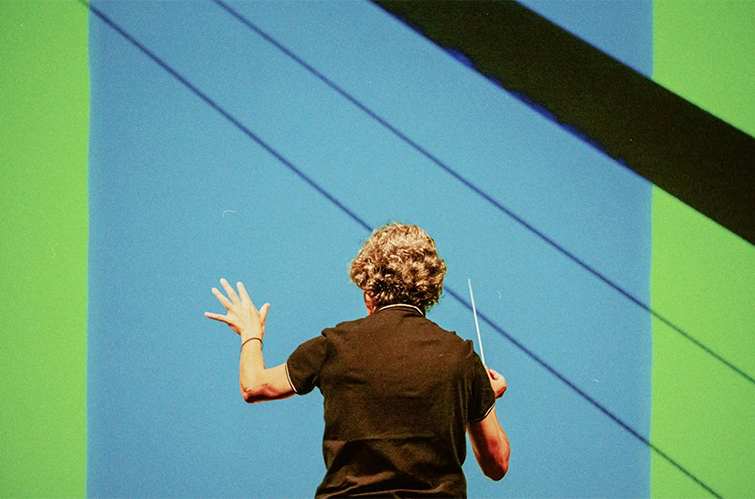 Pedro Neves · © MãoSimMão A word for the OML and its conductor Pedro Neves, who are committed to bringing the score to life and exploring its diverse sonic possibilities. The OML demonstrates exemplary openness and dedication to the interpretation of contemporary music, applying the same intent and dedication to the exploration of today’s musical art as it does to any work in the repertoire. Some interesting ideas in the composition seem to emerge too late, near the end, in a new section where Pedro Neves conducts as if improvising with the orchestra, for example (with a sound reminiscent of ‘tuning the orchestra’ amongst the possible gestures) and immediately afterwards, where it almost seemed to us that another piece might begin, leading into the bridge we’ve never heard like this before, so that, through the ‘transductions’ of Simão Costa’s piano, we might feel the vibration of freedom more intensely. |
|