| >> Versão Portuguesa |
|
| 2026.01.07 Closing concert of the Festival Itinerante de Percussão 2025 (Travelling Percussion Festival) with premieres of works by Bernardo Lima, Nádia Carvalho and António Pinho Vargas Tuesday, December 30th, at 7h30 p.m., Oriente Foundation Auditorium, Lisbon. |
|
| A Festival Where Percussion Thrives PEDRO BOLÉO |
|
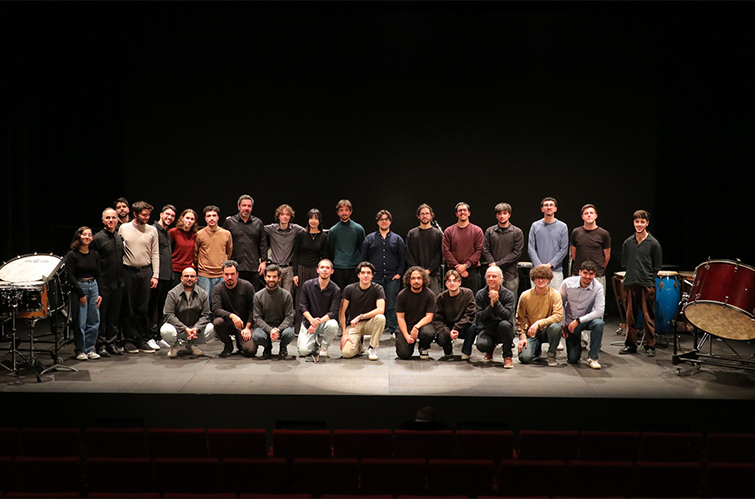 Participants at the FIP — Festival Itinerante de Percussão 2025 One could simply say that it was a beautiful concert on Tuesday evening at the Museum of the Oriente Foundation in Lisbon. But it wasn’t just any concert — it took place in an exceptional context. The FIP — Festival Itinerante de Percussão (Travelling Percussion Festival) is organised by the Arte no Tempo association and has been held in various cities across the country since 2018. This year marks the sixth edition of the festival (it was not held in 2020). In 2025, it took place at the Lisbon School of Music and the Oriente Foundation Museum. The festival brings together seven Portuguese higher education institutions that offer Percussion courses. These are the National Superior Academy of Orchestra / Metropolitana (Lisbon), the School of Music and Performing Arts / IPP (Porto), the Lisbon School of Music / IPL, the School of Applied Arts / IPCB (Castelo Branco), the University of Aveiro, the University of Évora, and the University of Minho. For four days, young percussionists from seven higher education institutions come together in septets to prepare a new piece of music, which is composed by a Portuguese composer and premiered at the festival’s closing event. Percussion masterclasses are also held during this time, led by percussionists and teachers, and these are open to secondary school students too. This year, masterclasses were led by Marco Fernandes (timpani and orchestral percussion), André Dias (snare drum), Jeffery Davis (vibraphone) and Vasco Ramalho (marimba). Pedro Carneiro, Nuno Aroso and João Dias were also involved, preparing new works for percussion septet presented on the last day of the FIP. The festival also included recitals by soloists, bringing together teachers and students — young percussionists chosen among the ones who had responded to a call for participation. We are therefore faced with an event that is much more than just a series of concerts; it is an integrated initiative involving learning, sharing, creation and listening, with an important artistic and educational dimension. The initiative’s main originality lies in its itinerancy, which allows percussion teachers and students from schools across the country to come into contact with each other. The results are clear to see: six editions have been held, 18 new works for percussion septet have been premiered, and fruitful contacts have been established between percussionists — breaking down rivalries between schools, offering productive collaborations and fostering encounters and learning, with practical proposals closely linked to new creations. We appreciate your patience while we provide this essential, albeit lengthy, explanation. It is important to understand that this concert is not an isolated event, but rather the grand finale of an intense process involving a festival directed and produced by Diana Ferreira (from Arte no Tempo) and Mário Teixeira (a teacher and percussionist who introduced the concert and spoke briefly about the event between pieces, inviting the composers of the three compositions to share their thoughts on their work). Now, let us finally get to the concert. A wooden theatre, a journey through metal, and a study of leather The first piece, entitled Materia Lignorum and composed by Bernardo Lima, was performed by Filipa Ribeiro, Simão Pereira Veiga, Afonso Bessa, Rodrigo Pinho, Amadeu Lança, Yi Huang and Raúl Eira. Each of these students came from a different school. João Dias was the musical director in this case. Materia Lignorum is a piece in which wood is the main protagonist, but the voice also appears, as if it were ‘a woodworm’, as the composer said when he took the stage. The piece combines instruments with a defined pitch, such as the marimba, with instruments that have an undefined pitch. It explores the sound of wood through timbre, sometimes seeking unusual sounds, such as the marimba being played softly with the hands and without mallets. It is a challenging and sensitive composition that unfolds not as a story, but almost as a play. It is as if we were entering a kind of wooden house with our ears, for a captivating game of soft listening where browns and yellows dialogue and where scraped or caressed sounds emerge — never harsh, even when they raise their voices. When, at a certain point, the music seems to start again as at the beginning, everything is ultimately different in this theatre of sounds. Another stimulating piece, though quite different in character and timbre, was Nádia Carvalho’s Echoes of Alloy: Of Shards and Shimmers. This was another premiere, performed by students Gabriele Petrucci, Gustavo Silva, João Ferreira, Micael Ferreira, Isaque Andrade, Hélder Santos and Rodrigo Loureiro. The musical director here was the percussionist and maestro Pedro Carneiro, who faced the challenge of leading a piece in which much was not written in the traditional way. As the title suggests, this piece focuses on metal percussion and features instruments such as the vibraphone and gongs, as well as more unusual ones like car brakes and flexatones. The composer presented it as a study of the timbre of metal, which can be not only solid, but also liquid and even ‘vaporous’. While Bernardo Lima’s piece was a theatre of sounds, Nádia Carvalho’s was a much more abstract journey, with metallic sounds suggesting landscapes where they merge, meet, or drift apart. Along the way, it left us listeners to discover blue trees, grey stones and metallic green clouds in our imagination. Finally, António Pinho Vargas’s piece Dissolves me into geometrics was performed by a septet comprising Carolina Gomes, Diogo Pinto, Francisco Franca, Bernardo Ramos, Leonardo Simões, Pedro Arrieche and Paulo Dias, and conducted by Nuno Aroso, in the Auditorium of the Oriente Foundation. This piece, which uses leather percussion instruments with no defined pitches, was created in response to a challenge issued by Arte no Tempo. The limitations of the commission seem to have stimulated the composer, who undertook a musical and sonic investigation that focused less on pitch — although contrasts between low and high notes are important in the piece — and more on dynamic interplay (always rhythmic, of course!), as well as an intriguing dimension of sound spatialisation that worked particularly well in that auditorium. Like those of its younger predecessors that evening, this piece also has a study aspect. Here, however, it is a poetic study, combining rhythmic exercises (e.g. accelerandos, ritardandos, and imitative games between the seven instruments) with sections in which obsessions and ‘geometric’ ideas seem to linger. All this without ever neglecting the formal play in which dynamics (from piano to fortissimo) take precedence, within the framework of a timbral exploration based on the sounds of the leathers (from congas to large bass drums). This is a jovial piece by António Pinho Vargas, perhaps inspired by the healthy atmosphere of this FIP encounter, which brings together percussionists, students, teachers and creators from various generations. Or one could simply say: what a beautiful concert! With a cymbal, tchhhh, acknowledging the festival. |
|