| >> Versão Portuguesa |
|
| 2026.05.04 2026 Música Viva Festival – Insurgency April 28th – May 3rd, São Luiz Municipal Theatre, Lisbon. |
|
| Insurgent Música Viva kicked off at São Luiz (part 1) (Música Viva Festival — concerts on April 28th, 29th and 30th) PEDRO BOLÉO |
|
|
The Música Viva Festival completed its 32nd edition — quite an achievement! This event dedicated to contemporary musical creation, an initiative of Miso Music Portugal, this year took place at the São Luiz Theatre in Lisbon under the theme ‘Insurgency’, once again establishing itself as a space for freedom, critical thinking and transformation, and affirming the musical art of our times as a practice that ‘not only reflects the world, but acts upon it’, as Miguel Azguime said in his brief introductory remarks at the Festival’s opening concert. Brand new music and a Messiaen that reaches for the heavens 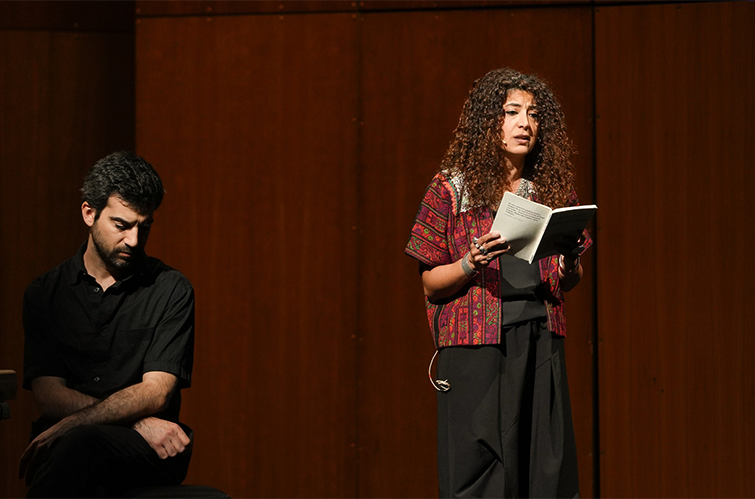 João Dias and Shahd Wadi © EGEAC – Teatro São Luiz, Pedro Rosário Nunes The first concert, on the evening of Tuesday, April 28th, was preceded by an artistic interlude featuring a poetry reading by Shahd Wadi, described in the programme as a ‘Palestinian poet, amongst other possible roles’ (she is also a translator, researcher and an activist in movements for the liberation of Palestine). A powerful reading of a poem of her own, very much in line with the theme of this festival: ‘Insurgency’. The writer read a poem entitled Jasmine Rain, acting as the messenger of that ‘incurable disease’ which the Palestinian people also carry — hope. It was a beautiful opening to the concert by the Sond’Ar-te Electric Ensemble that followed, featuring three premieres of works by young Portuguese composers. 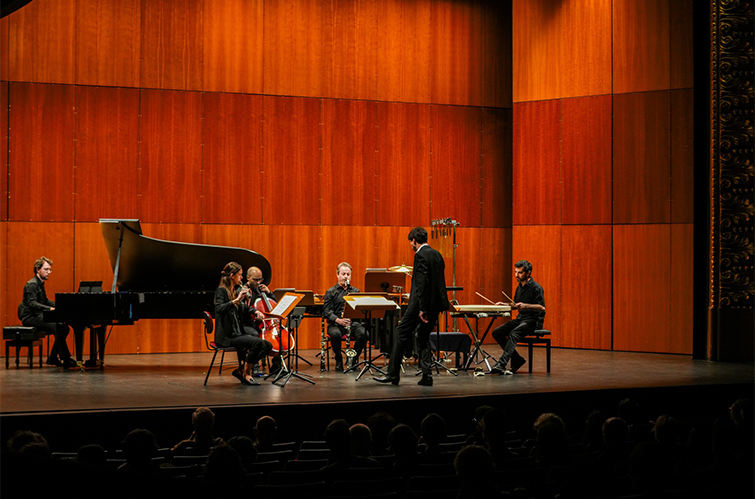 Guillaume Bourgogne and Sond’Ar-te Electric Ensemble © EGEAC – Teatro São Luiz, Pedro Rosário Nunes Particularly interesting was the first piece, pela pele, a brand new composition by Pedro Berardinelli (commissioned by the Viseu International Spring Music Festival and Miso Music), where the presence of a frame drum in the percussion section, combined with the title of the work, might have misled us. For from the outset, the spotlight falls not on the percussion skin, but on the bass flute, which Sílvia Cancela played masterfully. It is the flute that articulates the core of the discourse, which becomes collective and draws on the sounds of the human voice — spoken and sung — even before the flute comes into play. Later, the other musicians are invited to sing whilst they play. In addition to the percussion (João Dias) and the aforementioned bass flute played by Sílvia Cancela, pela pele also features the cello (Filipe Quaresma), the bass clarinet (Nuno Pinto) and the piano (João Casimiro Almeida), in a lively interplay of timbre and rhythm, which is joined at a certain point by... the audience!, who are invited to hold a sustained note for a while in pianissimo. Guillaume Bourgogne did an excellent job conducting, clarifying (for us in the audience too) the nuances of Berardinelli’s sensitive music. Next came Carlos Lopes’s piece, in Pulses, for violin, cello, clarinet, flute, piano and percussion (also commissioned by Miso Music), a work that seems to aim to push the ensemble’s sonic boundaries and which, in certain passages, succeeds in doing so, sounding almost like a chamber orchestra. At a certain point, easily recognisable quotations (Schubert, for example) disrupt the listening experience (like a listener who is delighting in unheard music and suddenly says: ‘but I know this!’). A free-spirited and humorous piece, with a dynamic interweaving of instruments, imitations of gestures, accelerandos and the discovery of common textures, resulting in something greater than the sum of the instruments. It was followed by Mafish Mushkila, a commission by the Sond’Ar-te Electric Ensemble to José Carlos Sousa. A very different approach from the previous pieces, this work explores melodic themes introduced by the cello or violin, which are then further developed. Seemingly conventional in structure, Mafish Mushkila (which in Egyptian means something like ‘no problem’) surprises with its play on the detuning of the scales, where beautiful (perhaps melancholic) melodies are sung, symbolically evoking a desired serenity in the face of a disturbing world. Works that offer new sensibilities, an abundance of sound or a longed-for serenity in the face of a world at war: are these not also ways of being ‘rebellious’ in our times? The first Música Viva concert also featured a second half, in which the Sond’Ar-te gave an admirable performance of a landmark 20th-century piece, Olivier Messiaen’s Quartet for the End of Time. A special round of applause for Nuno Pinto’s superb clarinet solo in this remarkable work, noted for its astonishing music and the harrowing context in which it was first written and performed in 1941, in a Nazi prisoner-of-war camp, with three fellow prisoners playing alongside Messiaen. A moving piece which, in its own way, is musically radical in the manner in which it takes us far — one might say all the way to Heaven, given its explicit religiosity — with boundless hope and trust in the beauty of life — birds included — and in the divine. Political Peixinho and United People variations 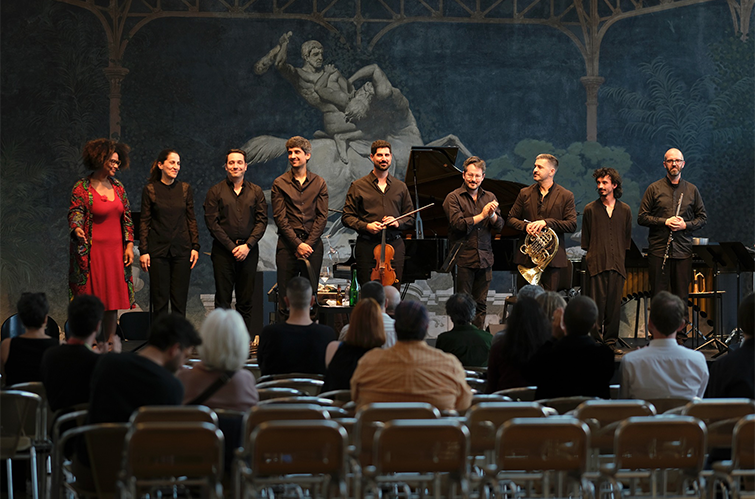 Ensemble mpmp © EGEAC – Teatro São Luiz, Pedro Rosário Nunes The following day, the Festival hosted a concert at 6 p.m. in the Jardim de Inverno (Bernardo Sassetti Hall) featuring the Ensemble mpmp performing ‘Peixinho Político’, a programme of three works played back-to-back — a choice that made perfect sense, even though it brought together three pieces with very distinct aesthetic approaches: CDE, from 1970, for clarinet, violin, cello and piano (the title refers to the Democratic Electoral Commission which attempted a campaign for free elections that the fascist regime once again prevented), Elegia a Amílcar Cabral (an electronic piece constructed from 12 sinusoidal sounds, of disarming simplicity, almost static, composed following the 1973 assassination of the leader of the PAIGC [African Party for the Independence of Guinea and Cape Verde]), and a piece written after the April 25th Carnation Revolution, A Aurora do Socialismo (Madrigale Capriccioso), for ensemble and electronics, with a freshness that has stood the test of time, at least judging by the lively performance by the Ensemble mpmp on the afternoon of April 29th. This concert was preceded by poems by Gisela Casimiro, read by the author herself in a delicate yet deeply committed manner, inviting the audience to reflect on freedom, racism and the new forms of imprisonment that surround us in these difficult times. mpmp delivered a meticulous and rigorous performance, though it lacked just a touch more verve in the piece CDE, a beautiful work for ensemble by Jorge Peixinho, one of the most notable Portuguese composers of the 20th century. 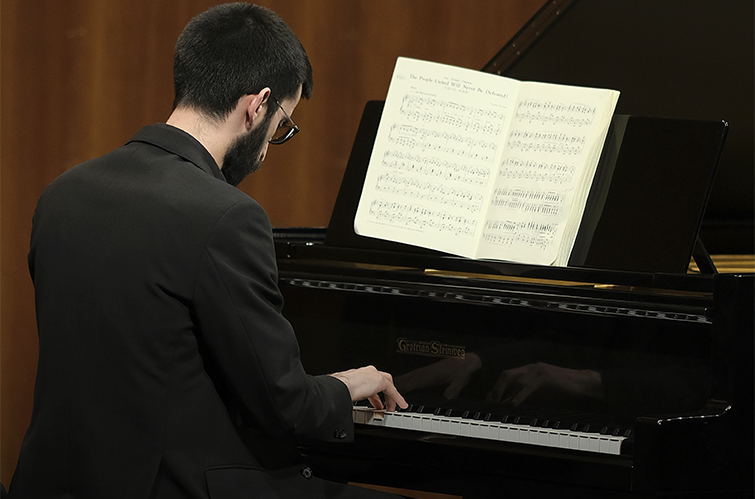 José Pedro Ribeiro © EGEAC – Teatro São Luiz, Pedro Rosário Nunes On the evening of the 29th, it was José Pedro Ribeiro’s turn to give a monumental recital, beginning by performing Prelude, Song and Dance by Fernando Lopes-Graça with intense energy, before embarking on Frederic Rzewski’s frenzied variations on the famous theme ‘El Pueblo Unido Jamás Será Vencido’ (the original Chilean song by Sergio Ortega and Quilapaiún, which served as an anthem for Allende’s socialist government and the Chilean people’s struggle for freedom, violently suppressed following Pinochet’s coup and his murderous repression). A piece that is much more than a journey through 36 ‘states of mind’: The People United Will Never Be Defeated! does indeed possess an obsessive unfolding (though structurally rigorous in its sequence of 36 variations — derived from the song’s 36 bars — in six groups of six variations) that can be seen, beyond its intrinsically musical interplay (almost mad in its variety, virtuosity and the ‘detours’ it proposes), as a tribute to the victims of Chile’s tragic political defeat at the hands of Pinochet, an elegiac ode to social struggles in Latin America, and perhaps also as a sonic reflection on the history of the fight for freedom across the globe. A work brimming with rage and hope, on which José Pedro Ribeiro has done an extraordinary job, bringing this music — as excessive as it is moving — to life. Prior to this spectacular piano recital, Rosinda Costa gave a very careful reading of Jorge de Sena’s powerful Carta a meus filhos sobre os fuzilamentos de Goya, a poem-speech on present and future political and ethical responsibility towards all those who have been oppressed and sacrificed in the past. (Almost) Nothing Against and the legendary Drumming 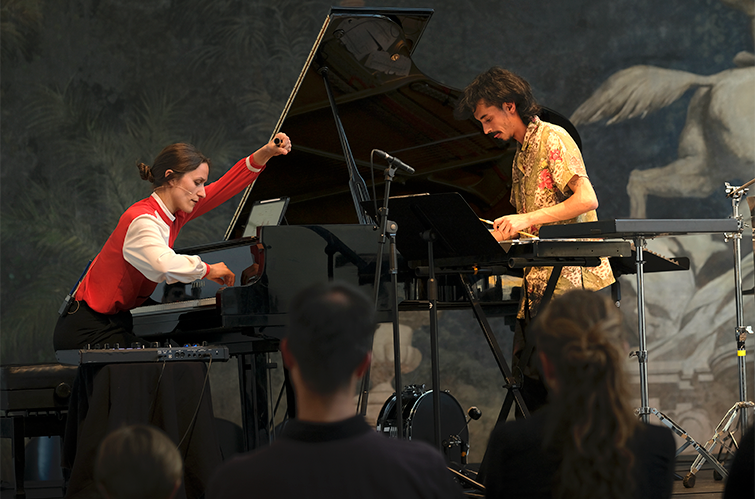 nada contra duo — Mrika Sefa and Francisco Cipriano © EGEAC – Teatro São Luiz, Pedro Rosário Nunes On the 30th, two more exciting concerts: one by Duo Nada Contra (in English ‘nada contra’ means ‘nothing against’), featuring Mrika Sefa and Francisco Cipriano, whose dynamic stage presence has the power to inspire new ways of creating (and listening to, and experiencing) the music of our times. For them, ‘insurgency lies in asserting intention, the primacy of the body and of labour, and standing together as a collective against the pressures of speed, uniformity and passive consumption.’ They performed highly experimental pieces, in some cases in progress (they work closely with composers), by Marta Domingues, João Quinteiro, Anda Kryeziu (who took to the stage and also participated in the performance of her work) and Valerio Sannicandro (Esercizi di morte was perhaps the most formally clear of the whole set). However, we felt that the selection of works presented lacked a piece that really cut through (in sound and fury). We felt that something fell short in the political gesture, and it seemed to us that it was a question of repertoire: the lack of a ‘screaming’ piece (or perhaps one of silence?) that would release the performance from its sometimes ‘landscapely’ soundscapes, or from the complex interplay with such diverse instruments (piano, MIDI keyboard, multiple percussion instruments, electronics or electronically transformed instruments). Once again, poetry was in the spotlight, with composer Marta Domingues opening the event by reading a poem (A Litany for Survival) by the American feminist, socialist, anti-racist and lesbian activist Audre Lorde, an iconic figure in the intersectionality of emancipatory struggles. The Nada Contra Duo performed all the pieces without interruption, using striking transitional sounds, such as a recorded voice reciting the words of the writer Primo Levi: ‘it happened, therefore it can happen again: this is the core of what we have to say. It can happen, and it can happen everywhere’. Between pieces, before the last one, there was room for a powerful poem read by Mrika Sefa, searching for the right words to describe and denounce exile and barbarism, expulsion and genocide. The ‘insurgency’ of this Música Viva also unfolded largely through poetry. 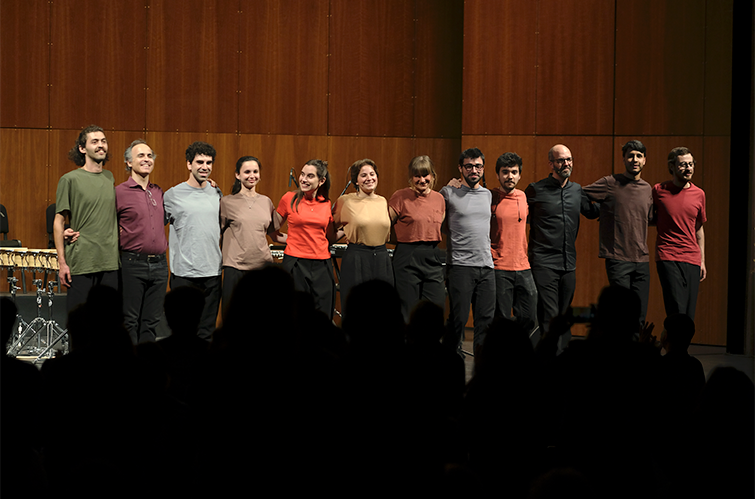 OCP Percussion Group with Pedro Carneiro and guest musicians © EGEAC – Teatro São Luiz, Pedro Rosário Nunes The evening began with an impassioned reading by João Morales of Com Sol e Sal, eu Escrevo, a 1977 poem by Sidónio Muralha, which speaks of a world ‘that sends flowers to the dead and throws stones at the living’. And, shortly afterwards, another concert combining a world premiere with a work that is almost part of the canon: Solange Azevedo’s new piece and a performance of Steve Reich’s Drumming, an iconic work of minimalism written in 1971. No Mesmo Espaço, by Solange Azevedo, is interesting in its exploration of diversity through the lens of light and colour, and features a rich treatment of the marimbas (set into vibration in various ways, not just with mallets), but it disappointed us somewhat in its vocal writing (where the text on light and human diversity in the perception of colours was rarely... perceptible). And then Drumming, that immense collective interplay of rhythmic shifts performed by Pedro Carneiro (percussion and also conducting), the percussionists Agostinho Sequeira, Marco Aleixo, João Braga Simões, Rafael Picamilho, Bárbara Ribeiro, Paulo Amendoeira, Madalena Rato and João Carlos Pacheco, the flautist Rui Borges Maia, the soprano Maria Grilo and the mezzo-soprano Markéta Chumová. The performers from the Portuguese Chamber Orchestra’s Percussion Group conveyed Steve Reich’s musical vision so effectively that we felt like joining in that game where it seems you can step in at any point. And they also conveyed — with precision, to be sure — the immense collective pleasure of making music, which is infectious in this radical and almost ‘legendary’ piece by Reich. Legendary, yet it may well be very much alive, just like this Festival, a place where stimulating contemporary composition, the vibrant performance of today’s music, and many curious ears come together. To be continued... |
|