| >> Versão Portuguesa >> Related Review — Insurgent Música Viva kicked off at São Luiz |
|
| 2026.05.08 2026 Música Viva Festival – Insurgency April 28th – May 3rd, São Luiz Municipal Theatre, Lisbon. |
|
| Música Viva: The premiere of a new quartet... (Música Viva Festival — concerts on May 2nd and 3rd) PEDRO BOLÉO |
|
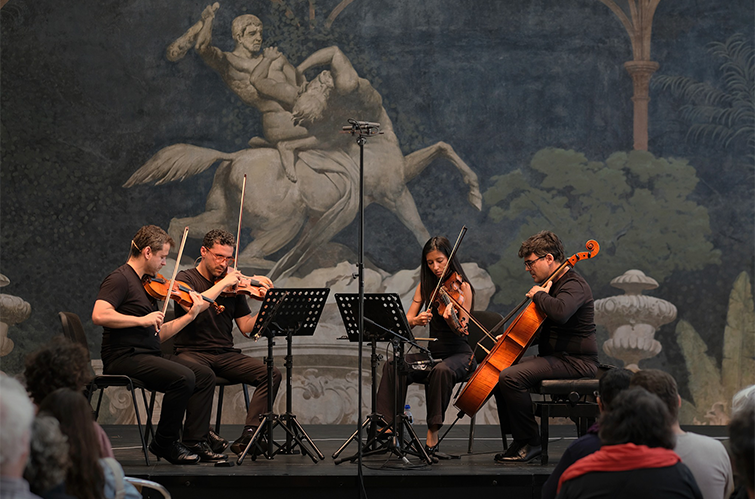 Miso String Quartet © EGEAC – Teatro São Luiz, Pedro Rosário Nunes A new ensemble dedicated to contemporary music has emerged: the Miso String Quartet, which made its intergalactic premiere on the penultimate day of Música Viva, in an excellent Saturday afternoon concert at the Sala Bernardo Sassetti of the São Luiz Theatre in Lisbon. An ensemble that promises to devote itself to completely new music, but also to the ‘established’ repertoire for string quartet up to the 20th century. The Miso String Quartet comprises Pedro Lopes (first violin), César Nogueira (second violin), Joana Cipriano (viola) and Luís André Ferreira (cello). But it was the actress Joana Santos who kicked off the afternoon, delivering a superb reading of short passages by Gonçalo M. Tavares, including O desempregado com filhos (The Unemployed Man with Children), a poem of biting sarcasm that was clearly inspired by the tone and terse style of some of Bertolt Brecht’s poems. An ironic outburst that left one gasping for breath. 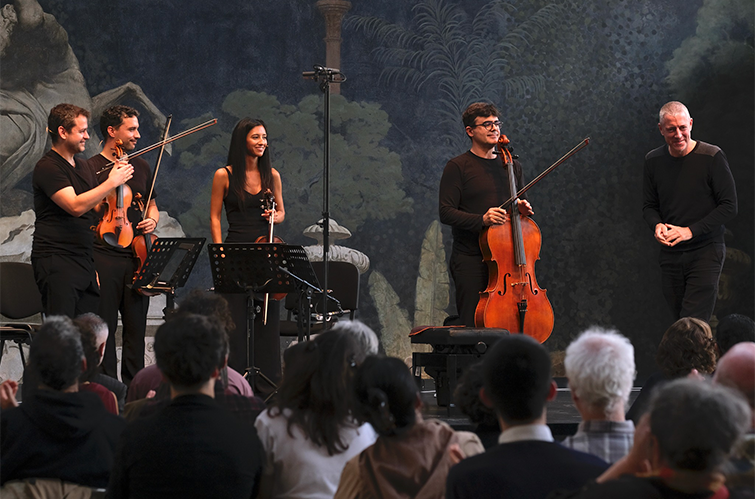 Miso String Quartet and Diogo Alvim © EGEAC – Teatro São Luiz, Pedro Rosário Nunes Musically, it all began with Diogo Alvim’s piece, Tłumaczenie, a string quartet from 2015, originally written for the Polish group, Royal String Quartet, and premiered in Belfast. The work draws on an experience of translation between architecture and music (Diogo Alvim also holds a degree in Architecture), taking as its reference the ‘almost suspended’ building of the Music Department at Stranmillis College in Belfast. Tłumaczenie means ‘translation’ in Polish, and the piece attempts, across three movements, various exercises in ‘translation’: of the textures and timbres of Penderecki’s music, of the work of the visual artist Edward Krasiński (in particular the ‘blue line’ that runs through several of his works) and of a novel by Stanisław Lem (The Master’s Voice). The result of this triple inspiration (musical, visual and literary) is an extremely successful work, in which noises are the primary sound material (strong pressure of the bows on the strings or the use of percussion on the bodies of the instruments or even on the music stands). A piece that creates challenging (sonic) spaces through which one feels like wandering, and which showcased the Miso String Quartet’s sonic quality, from the opening pianissimo to the faster, more energetic sections, where almost angry glissandos emerge, yet never veering off course. One also sensed a performative energy that never lets the listener switch off for a moment and which captured well the ‘suspended’ aspect of this work of impossible translations. 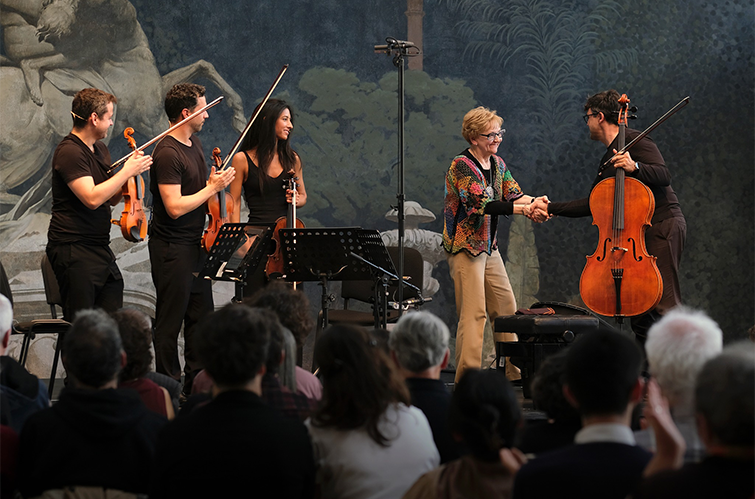 Miso String Quartet and Doina Rotaru © EGEAC – Teatro São Luiz, Pedro Rosário Nunes Up next was Doina Rotaru’s Vivarta, a work unafraid of sweeping gestures, yet far from romantic in character. Rather, they emerge as revitalised dynamics, like memories. The most interesting aspect of the piece is that it treats every line and every musician as living entities within a moving whole, without losing sight of what is being woven collectively. It could be the soundtrack to a human (collective?) memory, built from archaic melodies of Romanian music that create a continuous soundscape, at times interrupted (for example by a break in the cello), only to resume its narrative shortly afterwards. Vivarta is a word from Hindu philosophy with multiple meanings, including those of transfiguration and eternal return. This curious piece by Rotaru does just that: continuous transformation, in a sort of sonic spiral where everything returns and changes incessantly. Once again, the Miso String Quartet is in great form, weaving the necessary connections to reveal the piece’s fabric. Finally came Steve Reich’s Different Trains, a 1988 piece for string quartet and tape. The musicians play, in a sense, ‘over’ the recording, which is the fifth element, almost a guide for the musicians, including sounds of trains, pre-recorded sounds of the quartet, train sirens and warning bells, and fragmented voices emphasising the melody of speech through repetitions (and overlaps with the instruments). In a way, we are faced with several superimposed quartets, lending an unexpected density to a relatively simple procedure, as indeed Steve Reich practised in many of his pieces. The musicians often play in time with the fragments of the spoken melody, which allows us to see the performers’ technical dexterity in a different light from the usual. Here, the virtuosity is of a different kind — drawing us into these trains (and these lines), which are those of Reich’s childhood in the USA, but also those of the Holocaust during the Second World War in Europe and those of the post-war period, now marked by terror, but perhaps also by a new hope. The ever-changing interplay of repetition, the visible and audible concentration of the musicians, and the ‘trains’ on which the performers and the composer place us (audibly), all bring emotion to the surface where one least expects it, in an experience that, live, is at once strange and moving, ‘across a strange wonderful land’, as a Johnny Cash song goes (also featuring trains). A fine performance by the Miso String Quartet, which shows it’s ready to play anything — let’s keep an eye out for them. 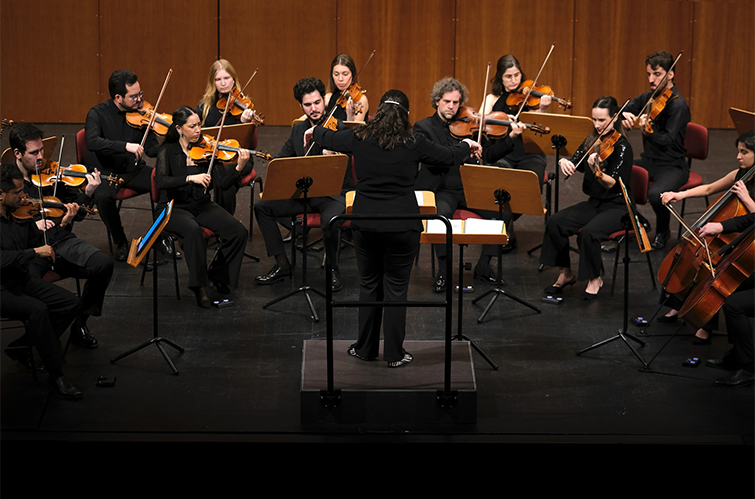 Sinfonietta de Braga, with the conductress Rita Castro Blanco © EGEAC – Teatro São Luiz, Pedro Rosário Nunes Unfortunately, we were unable to attend the concert by the Braga Sinfonietta, conducted by Rita Castro Blanco, featuring a programme ranging from György Ligeti (Ramifications), Alban Berg (Three Pieces for string orchestra from the Lyrical Suite) and Tōru Takemitsu (Requiem for string orchestra) to contemporary composers such as Bruno Gabirro (whose spectacular Rebel (Chaos), from 2008, was performed) and Carlos Brito Dias (with the delicate and fascinating work was birgst du so bang dein Gesicht?, from 2022). We would simply note that this is one of the hallmarks of this Festival, bringing together important works from the 20th century (or by well-known composers) with pieces by Portuguese composers, some of which are world premieres or very recent works. Before the concert by the Braga Sinfonietta, Miguel Azguime read from Os Lusíadas, Canto IV, stanzas 94–104 by Luiz Vaz de Camões, the famous episode of the Velho do Restelo (Elder of Restelo): «Mísera sorte! Estranha condição!» (‘What a wretched fate! What a strange condition!’) ... and a firm closing 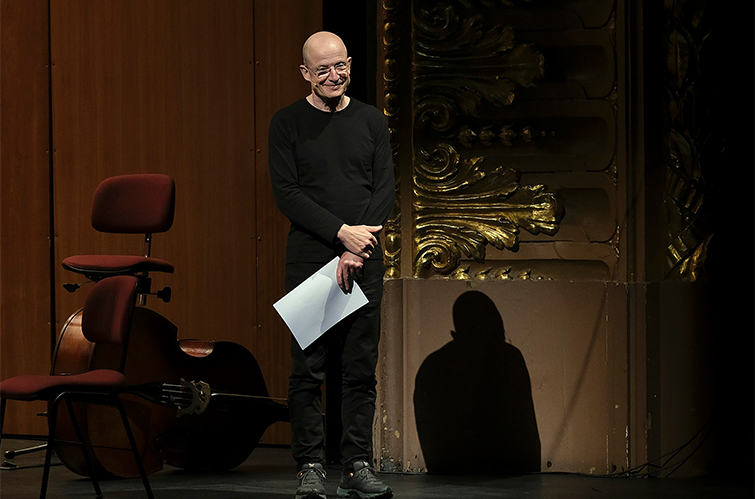 Miguel Azguime © EGEAC – Teatro São Luiz, Pedro Rosário Nunes A few more words on the powerful finale of the Música Viva Festival, featuring Azguime’s Triple Concerto alongside Beethoven’s Triple Concerto. Miguel Azguime began by reading poems by Mário Dionísio, originally written in French, from the 1967 book Le Feu Qui Dort. Poems of love and anger, of despair and the struggle for freedom, which resonate powerfully in these difficult and demanding times. It was followed by Against Silence – Triple Concerto for Clarinet, Cello, Piano and String Orchestra by Miguel Azguime, a work that seemed to be part of the ‘repertoire’, such was the ease with which it was performed by the Lisbon Metropolitan Orchestra. It is true that the conductor Pedro Neves knows it well (he has already performed and recorded it with the Camerata Alma Mater), but it is nonetheless surprising that it now seems like a piece ‘that would be normal to perform’, when in fact it is a piece that pushes the boundaries, demanding difficult things of the performers — microtonalities, attention to the ensemble sound, constant shifts in character — and creating in us listeners something that compels us to act — between anguish and exasperation, between despair and struggle. The verses of Dionísio read earlier echoed — a fire that lay dormant, awakens — ‘comment le taire?’ For Azguime, what is at the heart of it all is free creation, in an incessant search within sound. 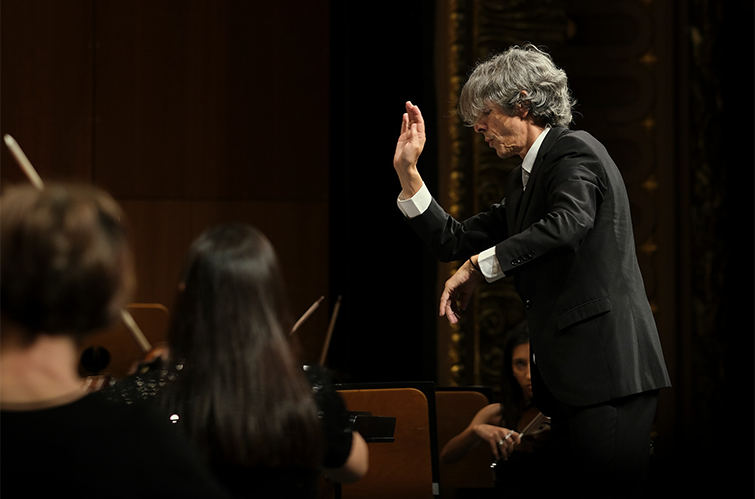 Pedro Neves © EGEAC – Teatro São Luiz, Pedro Rosário Nunes Against Silence is an exploration ‘within’ (into the poetry of sound and its intrinsic qualities), but also, more so than his other works, a search ‘outside’, in society, alongside his fellow musicians (the soloists Filipe Quaresma, Nuno Pinto and Elsa Silva shone, at times in intriguing conversational trios), and a conductor who understands his music well, Pedro Neves. But also wishing to convey this dissonant beauty to the ears of the world — because Against Silence is also a cry of resistance and creative freedom, a weapon against barbarism. Then came Beethoven. A Triple Concerto he began composing in 1803, at a turning point in the composer’s career, when he fully embraced his art as a quest for an ideal, rebelliously if necessary (these were the days of the Eroica). With Vítor Vieira on the violin (in fine form, it must be said), alongside Elsa Silva on piano and Filipe Quaresma on cello. A concerto with minor interpretative imperfections (some issues with rhythm), but a joy that was nonetheless infectious. Here too, Beethoven desperately offered humanity hope. |
|